


Why Kentucky Bowhunters Should Be Practicing Right Now

There’s a certain stretch of the year in Kentucky when deer season still feels comfortably far off.
The hardwoods are full and green. Creek bottoms are thick. Ridges hold that heavy late-spring hush before summer settles in for good. Trail cameras are getting fresh batteries. Access routes are being thought through. A few hunters are already studying where deer may feed, bed, and travel when September gets here.
And in plenty of garages across the state, bows are still hanging untouched.
That is usually how the slide begins.
A person tells himself or herself there’s time. June turns into July. July slips toward August. Then one evening, with opening day suddenly in sight, the bow comes down, a target gets set out in the yard, and practice becomes less about preparation and more about catching up.
That approach can work just enough to be dangerous.
Because Kentucky’s early archery season often offers some of the most straightforward deer movement a hunter will see all year. Deer are still tied closely to food, water, shade, and low-pressure cover. In the right places, a good buck may hold to a dependable summer pattern, easing out along an oak flat, skirting a secluded creek crossing, or stepping through the edge of a clover plot before dark. The opportunity can be there. But opportunity only matters if the shot is ready when the moment comes.
That is why archery practice in late spring and early summer matters so much.
Not because a hunter needs to stand outside and burn through a hundred arrows every evening. Most of the time, that just builds fatigue. Good practice is quieter than that. More deliberate. It is the steady work of returning to a clean shot sequence before bad habits get rooted. It is learning to trust your anchor point again. It is rediscovering what a settled pin looks like. It is making the first arrow count, because that first arrow is the one that matters in a deer stand.
The best practice sessions usually start small.
Ten yards. Then twenty. Then thirty. Not for ego, and not for social media. Just for consistency. A person who can group arrows cleanly at ordinary bowhunting distances is doing more for opening day than the hunter flinging arrows at long range without discipline.
And after that foundation is back, practice ought to start looking a little more like the hunt itself.
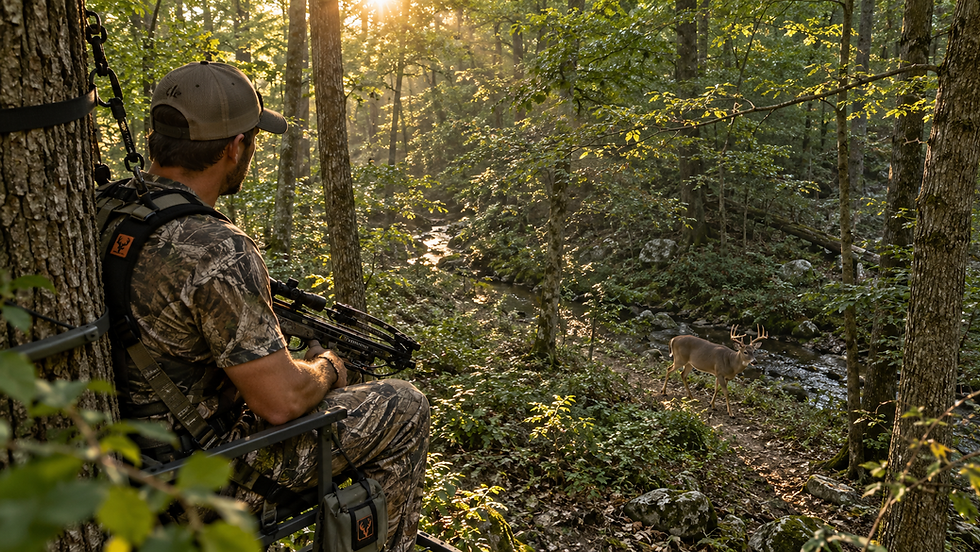
That means shooting one cold arrow before anything else. It means putting on the jacket, facemask, or release setup you may actually wear in September. It means practicing from a seated position, from a kneeling position, and, when it can be done safely, from elevation. Kentucky hunting is full of angles, uneven footing, brush, and moments that do not arrive under perfect range conditions. A shot on level ground in the backyard is one thing. A shot from a tree over a shaded trail in a holler is another.
That difference is where practice becomes valuable.
Of course, not every bowhunter has a private setup at home. For plenty of folks, that is the very thing that keeps practice from happening. The good news is Kentucky does offer places where a person can shoot without needing a back field or a homemade target lane.
The KDFWR Headquarters Archery Range in Frankfort is one of the better public options, especially for hunters wanting multiple yardages and a more structured setup. Miller Welch Central Kentucky WMA gives archers another strong place to practice, with both standard shooting distances and a woodland-style course that feels a little closer to real hunting. Around Louisville, Tom Sawyer State Park offers a dependable public range for routine summer reps. In the Lexington area, Hisle Farm Park is another practical option for hunters who simply need a solid place to shoot on a regular basis.
And that may be the biggest part of the whole thing.
Sometimes the obstacle is not knowledge. Most hunters already know they need practice. It is not equipment, either. Most already own what they need to begin. More often, the obstacle is delay. The habit of thinking there will be more time later.
But later has a way of showing up all at once.
By the time September arrives in Kentucky, a bowhunter ought to feel calm stepping into range, not uncertain. The release should feel familiar. The sight picture should feel settled. The first arrow should feel like something that has already been made a hundred times in the mind and enough times in practice to trust it.
That confidence is not built the week before opener.
It is built now.


Comments