


Kentucky Bow Season 2026: Where to Find Deer Before the Acorn Drop Changes Everything

Opening weekend in Kentucky can put you in a strange spot as a bowhunter.
You may have spent August watching bucks step into a bean field on schedule, only to start second-guessing everything because September means acorns are coming. The temptation is to abandon those summer patterns and move straight into the hardwoods.
That can be a mistake.
Kentucky’s 2026 archery deer season opens Saturday, September 5, and runs through January 18, 2027. White oak acorns can begin falling in September, but that does not mean enough mast has hit the ground everywhere to immediately replace dependable summer food. University of Kentucky forestry information places normal white oak acorn fall generally from September through November.
Individual trees may already be dropping on opening weekend. The point is to find out, not assume.
1. Summer Food Sources Can Still Be the Starting Point
Soybeans, clover, agricultural fields, tender browse and other reliable green food can remain important during opening week.
KDFWR has noted that early-season deer favor edge habitat around cultivated fields, and that western Kentucky deer can be less mast-driven because agricultural food is so abundant.
If August glassing or cameras still show daylight use, do not abandon that information just because the calendar changed.
Hunt the safe side of the pattern: staging cover, shaded field corners or the first good trail inside the timber rather than marching to the bedding area.
2. Transition Routes Between Bedding and Food
The best opening-week stand may not overlook the beans at all.
Look for a fence gap, old logging road, narrow strip of cover or creek crossing connecting secure bedding with evening food. Mature bucks often give hunters a better daylight opportunity along that transition than they do standing in the open field.
Keep pressure low. One aggressive scouting trip through a September bedding area can erase the pattern you spent August building.
3. Shaded Creek Bottoms and Drainages
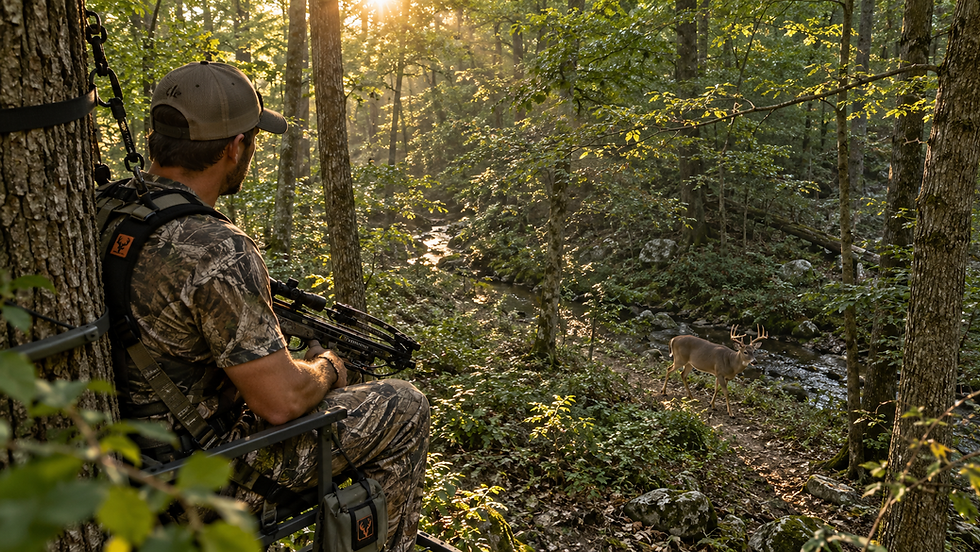
A wooded creek bottom can provide several things at once: shade, thicker cover, water and a natural travel lane between bedding and food.
That becomes particularly useful when an exposed ridge or field edge stays warm late into the afternoon. Check muddy crossings, inside bends and places where a drainage meets thicker cover.
4. Water Near Secure Cover
Recent Kentucky rainfall has not been uniform. The UK Ag Weather Center reported 2.06 inches statewide from August 12-25, 129% of normal, while Central Kentucky received only 0.93 inch-0.76 inch below normal for the period.
So this is not a reason to declare a statewide “water-hole hunt.” Check your property.
A creek pool, pond corner or spring tucked beside bedding cover can matter far more than exposed water sitting beside a road or barn.
5. Small, Overlooked Oak Pockets
Even while hunting summer food, start checking white oaks.
Look up before looking down. Find trees carrying acorns, then check underneath for fresh caps, newly fallen nuts, tracks and droppings. A handful of productive white oaks on a creek head or field-to-timber transition can eventually matter more than an entire oak ridge where little is actually falling.
WHY DEER ARE ACTING THIS WAY
Early September deer still have the basic priorities they had in late August: dependable calories, security, water and efficient travel.
KDFWR has long advised hunters to let the local mast crop influence where they hunt because heavy acorn availability can keep deer in the woods, while sparse mast encourages more use of other food sources.
As of August 28, I could not find a published 2026 statewide Kentucky mast assessment from KDFWR; the department’s current deer statistics page still lists the 2025 Kentucky Mast Report as its latest mast report. That makes boots-on-the-ground scouting especially important this opening week.
When the Acorns Start Falling, Be Ready to Adjust
Fresh white oak acorns can change a property surprisingly fast.
Kentucky Fish and Wildlife has noted that deer commonly favor white oak acorns earlier, with red oak mast becoming important later.
That means a buck using beans today may shorten his evening trip dramatically once a productive white oak starts raining acorns halfway between his bed and the field.
Do not wait until your cameras go dead to investigate.
A Few Hours to Scout? Use Them Here
Permission farm: Glass the main food source from a distance, then spend the remaining time checking the safest field-to-cover transition and several nearby white oaks.
Small private property: Avoid covering every acre. Check one low-impact travel route, your best water source and a handful of known oaks without entering primary bedding cover.
Kentucky public land: E-scout first, then walk one promising drainage, bench or oak pocket rather than wandering all afternoon. Pay attention to both deer sign and human access; KDFWR advises hunters to check the specific regulations for each public property.
2026 REGULATION NOTE
Kentucky changed deer-zone classifications in 30 counties for 2026-27, with all 30 moving into zones allowing higher harvest opportunity. KDFWR lists 17 counties moving from Zone 2 to 1, six from Zone 3 to 2 and seven from Zone 4 to 3.
Zone bag limits still apply, only one antlered deer may be taken statewide, and harvested deer must be Telechecked. Verify your county and any WMA-specific rules before hunting.
SAFETY REMINDER
Early September can still mean heat and long climbs in the dark. Stay hydrated, tell someone where you are hunting, and use a properly attached full-body harness every time you leave the ground.
SOURCES
Kentucky Hunting & Fishing Seasons Planner — KDFWR: https://fw.ky.gov/Hunt/Pages/ky-hunting-fishing-seasons-planner.aspx
Deer Hunting — Kentucky Department of Fish & Wildlife Resources: https://fw.ky.gov/Hunt/Pages/Deer.aspx
2026–27 Hunting & Trapping Regulation Guides — KDFWR: https://fw.ky.gov/More/Pages/Guides.aspx
Kentucky Fish and Wildlife Provides Recap of New or Amended Regulations: https://fw.ky.gov/News/Pages/Kentucky-Fish-and-Wildlife-provides-recap-of-new-or-amended-regulations.aspx
Deer Hunting Statistics / Kentucky Mast Reports — KDFWR: https://fw.ky.gov/Hunt/Pages/Deer-Hunting-Stats.aspx
Public Lands Hunting — KDFWR: https://fw.ky.gov/Hunt/Pages/Public-Land-Hunting.aspx
Kentucky’s Deer Season Starts Sept. 2 — KDFWR: https://fw.ky.gov/News/Pages/Kentuckys-Deer-Season-Starts-Sept-2.aspx
Kentucky’s Modern Gun Deer Season Opens Nov. 13 — KDFWR: https://fw.ky.gov/News/Pages/Kentucky%E2%80%99s-Modern-Gun-Deer-Season-Opens-Nov.-13.aspx
Kentucky Climate Summary, August 2026 — University of Kentucky Ag Weather Center: https://weather.uky.edu/kyclisum/kypmclisum_m2d.html
Kentucky Woodlands Magazine — White Oaks vs. Red Oaks, University of Kentucky: https://kywoodlandsmagazine.ca.uky.edu/sites/kywoodlandsmagazine.ca.uky.edu/files/kwm_15_1_2022.pdf
Trees, Shrubs and Vines / Oak Wildlife Value — University of Kentucky Forestry: https://forestry.ca.uky.edu/files/for68.pdf


Comments