


How Kentucky Deer Move in Mid-May: Green-Up, Creek Bottoms, and Fawning Cover

Mid-May in Kentucky has a different feel than fall. The woods are full again, creek bottoms are greening up, and the ridges have that thickening look that makes a deer disappear in two steps. This time of year, whitetails are not moving like they will in September, and they sure are not moving like they do in November. Deer season is closed now, with the next archery opener coming on September 5, so what you are seeing in the fields, hollers, and hardwood edges right now is pure off-season behavior. It is about comfort, food, water, and security more than anything else.
If you have spent any time on a Kentucky farm in May, you have probably seen the pattern already. The middle of the day gets warm, the woods go still, and deer tuck themselves into shade where the air hangs cooler. Then late in the evening, when the light softens and the edge comes alive, they begin to ease out. Not in a hurry. Not covering a big area. Just slipping from bedding cover to the nearest fresh feed with the least amount of exposure possible.
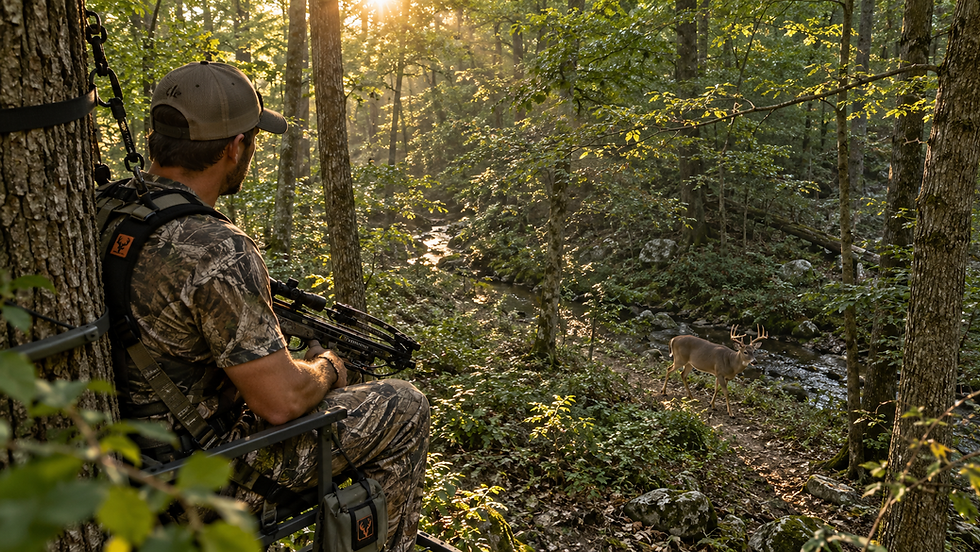
That is what deer movement looks like right now across a lot of Kentucky. A doe may spend most of her day close to a brushy field corner, an overgrown ditch, or a creek-bottom thicket where she can bed with cover at her back and water not far away. A buck, especially one carrying fresh antler growth, is doing much the same. There is plenty to eat in May, so deer do not need long daylight marches to fill their bellies. When food, water, and cover are stacked close together, their world gets smaller.
That is why the best places to watch this time of year are not always the big obvious food sources. Sometimes it is the little green pocket just off a crop field. Sometimes it is a shaded trail that drops into a creek crossing. Sometimes it is a ragged corner of a hay field where the brush is thick enough to make a doe feel safe. Kentucky deer have a habit of choosing the place that gives them everything they need without asking them to risk much to get it.
And with fawning season getting close, that cover matters even more. Kentucky Fish and Wildlife notes that very young fawns often lie out hidden in fields and other cover for the first couple of weeks after birth, which tells you a lot about how does begin to use the landscape this time of year. They start favoring spots with security, quiet, and nearby food. That means a lot of movement now happens tight to cover instead of out in the open where a hunter might like to see it.
If I was scouting Kentucky ground this week, I would not be tromping all over every ridge trying to force a fall answer out of a spring pattern. I would be watching from a distance. I would watch field edges in the evening. I would hang a camera on a low-impact route near a creek-bottom trail or a shaded corner where browse stays fresh. From the Bluegrass Whitetail gear list, a Bushnell Trophy Cam works fine if you want a simple budget option, a Tactacam Reveal makes life easier when you want quick checks without extra pressure, and a Spartan GoCam fits best on bigger places where you do not want to keep walking in.
The real lesson this time of year is that deer are telling you where they want to live before hunting pressure changes everything. In western Kentucky, that may mean the last green edge before dark near the beans. In the hills, it may mean a cool bench above a creek or a brushy cut between two hardwood points. Either way, the deer are not wandering aimlessly. They are settling into the easiest, safest pattern the land will give them.
That is worth paying attention to now, because the farms that hold deer comfortably in May often give you clues about where they will want to start the season later. Watch the green-up. Watch the water. Watch the cover. Then file it away for September.
Check back for more Kentucky movement updates, because this is the time of year when small details start turning into early-season patterns. And if you are out scouting, watch for ticks, snakes, and slick creek crossings, and make sure somebody knows which ridge or hollow you are headed into.
SOURCES


Comments